
Mulberry Tree
Up a ladder stained with paint and mulberry juice, I stand squinting through the canopy of the tree, trying to find the darkest, most ripe berries.
I hear Lutfun, our community gardener, walking over and come down as she introduces me to her son. They are both beaming with pride at each other, and she picks him some berries to try.
He is shocked at how delicious they are - we joke about the fact that, in all the time she's worked here, she has never taken any home for him to try. She argues that it’s because they don’t travel well, which is true - even the journey from the tree to the basket causes juice to ooze out and cover my fingertips in a burgundy sticky sweet syrup.
They walk off laughing and I continue to pick.
Moments later, Kirsten arrives with Rezia Wahid, a British – Bangladeshi textile artist, whom we are hoping to work with. She is thrilled to see a fruiting mulberry in London and quickly asks if she’d be able to buy a punnet.
‘Of course,’ I say.
Kirsten tells her that we are lucky enough to have two on the farm, and takes her off to visit the other one, whose fruits are less abundant but slightly larger and robust.
I move the ladder around and at points climb into the tree. An awkwardly high branch has five of the biggest mulberries I’ve ever seen. I pause to admire them in my hand before adding them to the basket.
At this height, the leaves are all splattered with juice from berries that have been half pecked by the birds.
Voices approach again, and this time Lutfun shouts up to me, ‘It’s my daughter - I didn’t know she was coming either!’
I descend to meet them and notice how similar they look. I pass her daughter some of the berries I’ve just picked, and again we joke that Lutfun’s been keeping them hidden from them all these years.
Lutfun tells us that she comes to the mulberry tree each morning she is at work and has a couple of the sweet berries to give her energy for the day.
It's the first time I’ve seen Lutfun with her family and it’s special to see her children here supporting the work she’s doing. They congregate a few steps away under the shade of the plum tree to catch up and enjoy a cold drink.
I decide that I’ve exhausted the tree and myself and come down from the ladder.
Back in the office, I start to weigh out what I harvested, as my colleagues organise the gathering of various gifts and a hamper of produce. I realise it must be nearing 1 o’clock. I finish weighing and head over to the kitchen garden, where everything has been arranged on a table.
Farokh from St John’s has arrived and is unloading the cargo bike full of pots and trays.
He has cooked us a lunch using as much farm produce as possible: red onion, harvested in the early spring and cured in the tool shed, dancing with freshly sun ripened tomatoes; A silver tray of glistening, roasted Kodu, dressed with a light oil and some spices; Kodu leaves, chopped finely and fried; A rich orange sauce in a saucepan, charred with the soot of a hot flame; And, at the end of the table, a large pot wearing a tinfoil hat.
Before we eat, we gather all the staff and volunteers on site - quite unceremoniously - into the kitchen garden. I sit down next to Lutfun. Phil turns to her and asks if she knows why we are all here. She says no.
‘Good!’
He explains that the 10th of July 2001, was Lutfun’s first day, which means today is the 25th anniversary of her employment. And so, we are here to celebrate her and thank her for the hard work and dedication she has shown the farm.
Lutfun is well-known in the area for growing vegetables very popular with the Bangladeshi-Muslim community. One of her specialties is Kodu, a beloved Sunnah (something the Prophet Muhammad PBUH did/ate) food in the Muslim faith.
As it dawns on her she is the celebrant for this, she starts to piece together why her family happen to be at the farm today. It’s revealed her son and daughter were both lying about having had meetings nearby that had cancelled, and that they knew all along we were having a lunch in her honour today.
I gesture at the table and tell her the gifts are for her. She laughs. She had thought that the produce was for the chef and is very grateful at what Chris has pulled together for her: peaches, plums, tomatoes, herbs, and of course a punnet of mulberries.
Hafsah shows her the basket which has a beautiful floral sari, some good quality gardening scissors, and a bunch of felt flowers made by Emma. Also on the table is a potted rose for her garden at home.
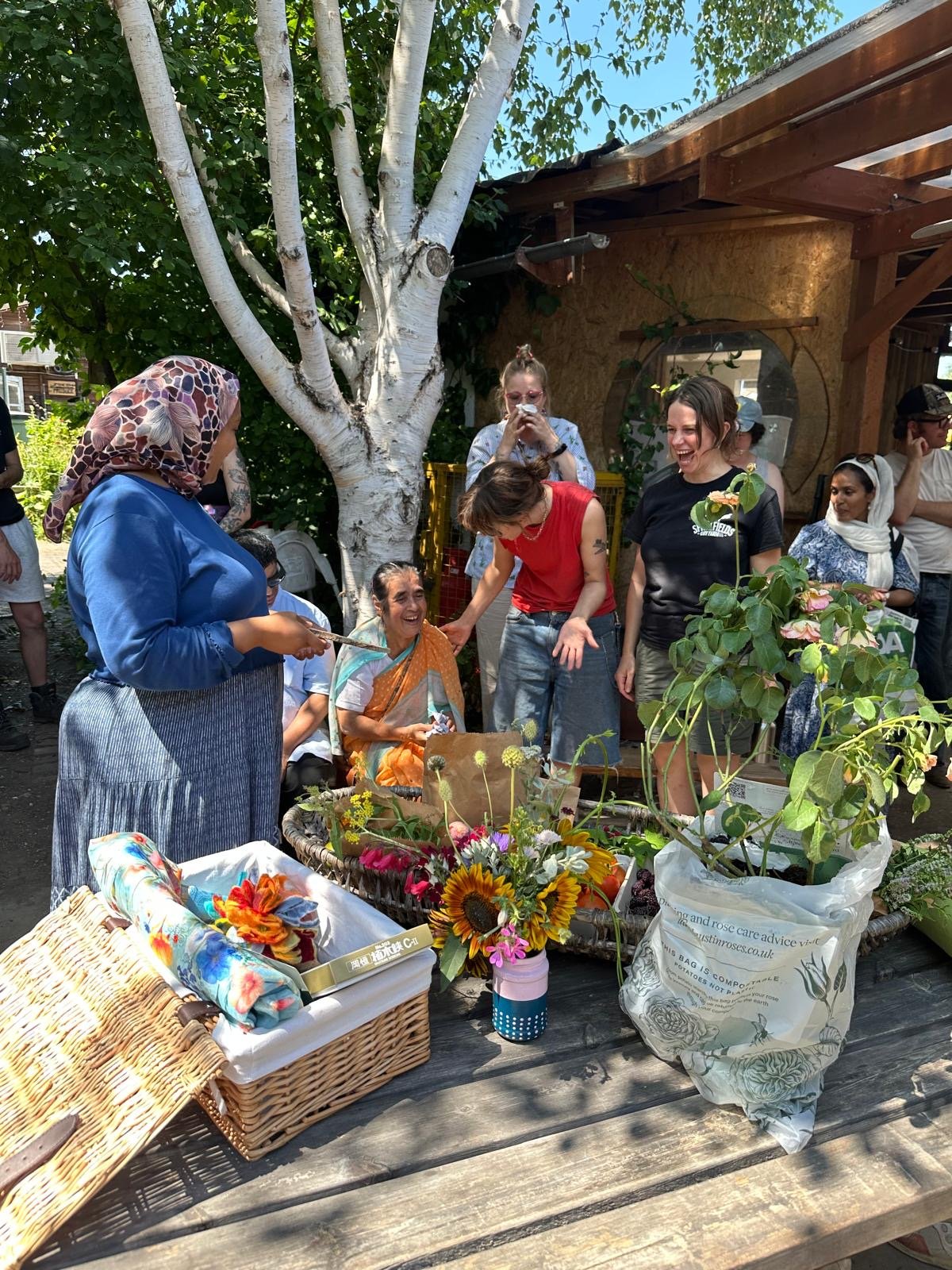
photo of Lutfun surrounded by farm staff and volunteers, her gifts presented to her on a wooden picnic bench taken by Simone
Then the foil hat comes off the big pot, and a mountain of Pilaf rice is revealed.
We all line up to fill our plates and eat - up and down picnic benches we sit and chat as the different colours mix on our plates. When I sit down with my second helping I notice Lutfun has gone back for more too - high praise indeed to the chef.
Sharing a meal together at the farm is a special time, and as much as we try and express through words out gratitude, there’s nothing quite like feeding someone with the literal fruits of their labour, letting their hard work reach its conclusion of becoming a nourishing meal.
Farokh then brings out an enormous pavlova piled high with whipped cream and mulberries, which all becomes increasingly pink as it’s cut into and served.
After lunch I find myself up the ladder again, but this time in the peach tree. The fruit is almost too ripe and is radiating the sweetest fragrance.
As I’m bending branches towards me to reach the fruits that have been weighing them down for the past month, I think about a recent conversation I had with Hafsah about the current social climate and how negative attitudes towards the Muslim community have become louder in recent months.
There have been far-right marches planned (and some luckily abandoned) just a short walk away from this sanctuary, which wouldn't exist in the way it does at all without the Muslim community.
Lutfun, who has always been kind and willing to teach me her methods of gardening, who when I grew my first kodu at my other job was genuinely proud of me and asked for pictures.
Hafsah, who has advised me on how to create events at the farm that will feel inclusive of the local community, and who has done the labour of educating the non-Muslim staff on how to increase cohesion by bringing up things we fail to notice.
Jay, who works with our young farmers, showing without having to try that someone who looks like them has a place at the farm and in the wider industry. Important not only to the Muslim children who see themselves in Jay, but also for the other children who subconsciously understand the respect and admiration people different to them deserve.
Then there's the countless Muslim locals who are regular customers doing some of their weekly shop with us, because they care about the organic growing practices we use and the unbeatable freshness of produce grown locally. It can be out of the ground and on their plates before the day is done.
The Muslim, Bengali, and wider community in tower hamlets has shown me an abundance of kindness, humour and reliability.
Even in times where language fails, I have been brought flowers.
When I lend my Sunday morning regular an umbrella, I know she will return it the following week, and that’s because the majority of visitors to the farm hold values of community as a central part how they live their lives - something which can often fall away without a pillar in the community.
At Spitalfields City Farm, that pillar is Lutfun.
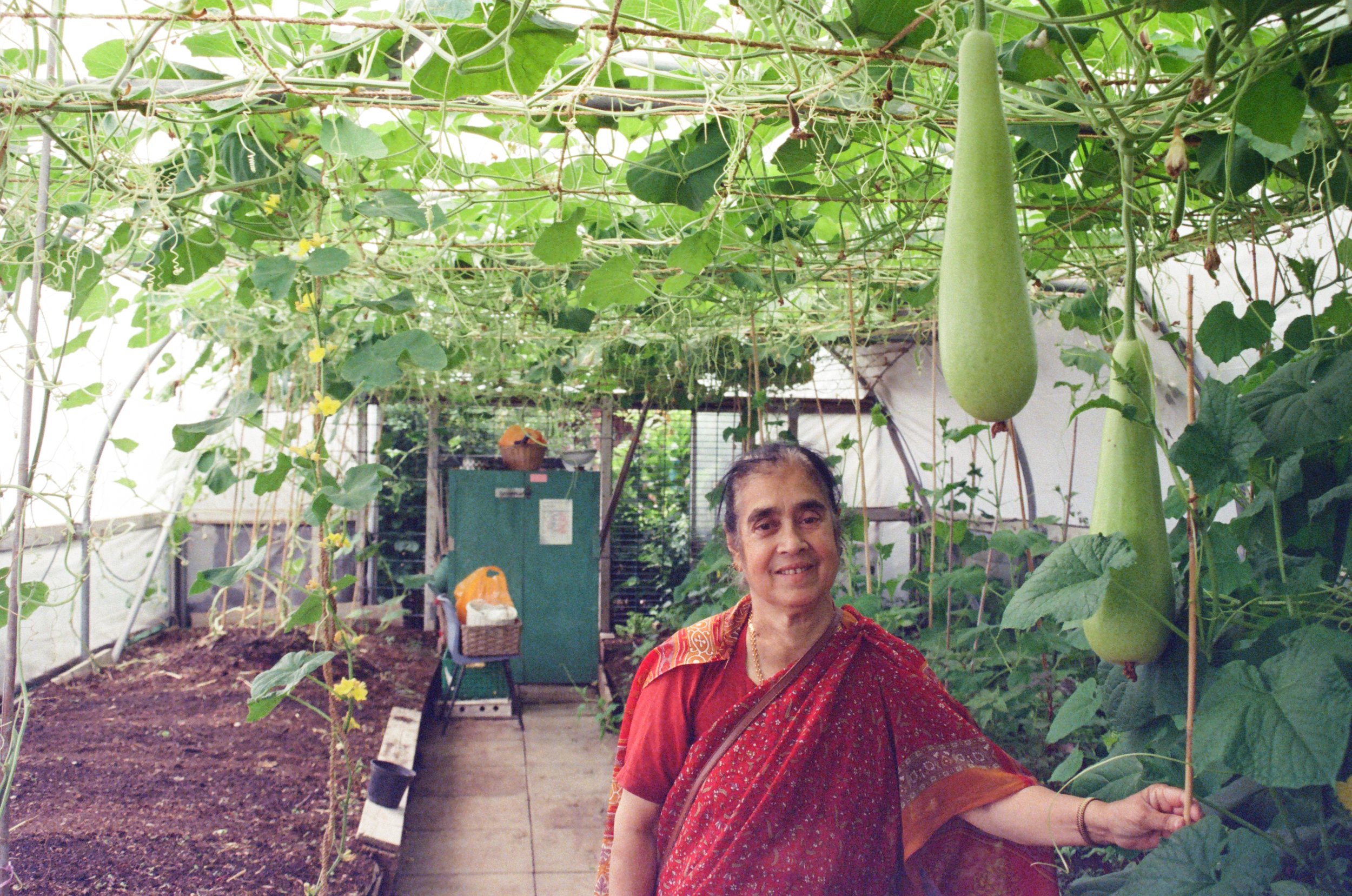
Photo of Lutfun in the poly tunnel where she’s been cultivating kodu for over 20 years taken by Izzy
Blog written by Izzy